
What a ‘harness’ is and why it matters
When you hire a very smart person, you don't just give them a computer. You give them a role, a boss, some rules, a budget and someone who reviews what matters. The same goes for artificial intelligence.
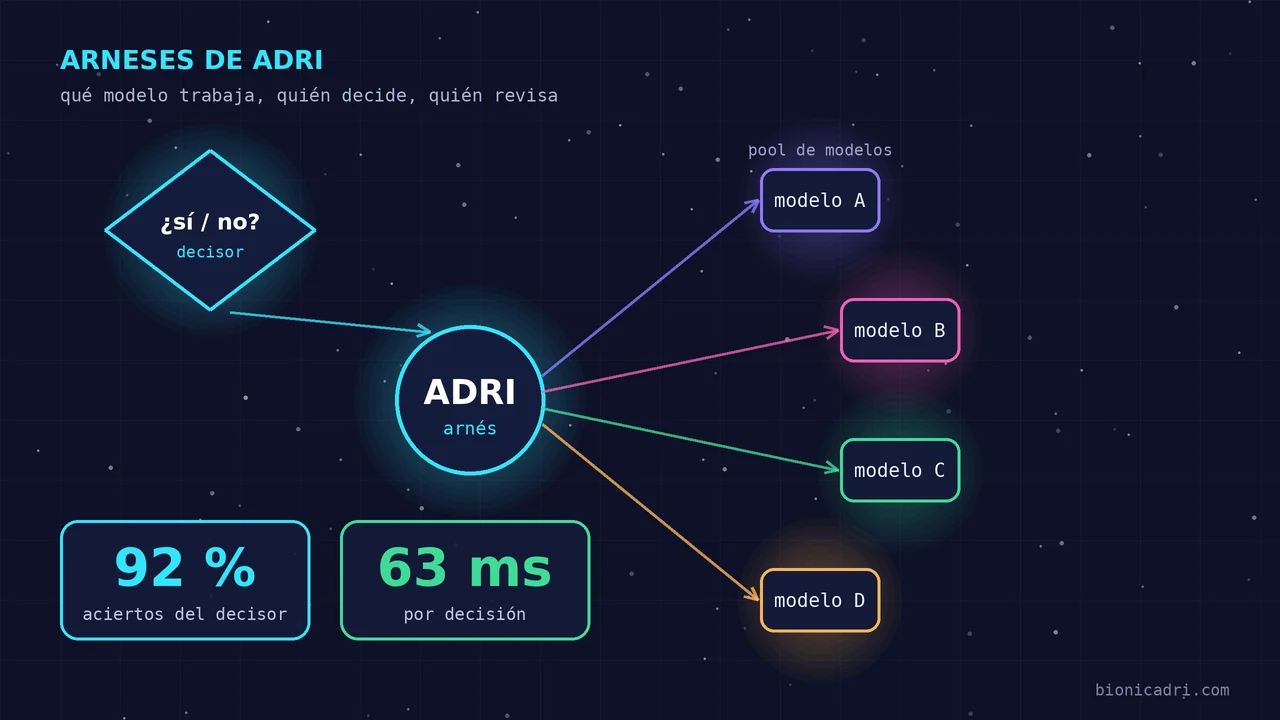
The harness is everything that surrounds the AI model: which model each specialist uses, how requests are distributed, what is retried, what is decided and when it stops. The model provides the intelligence; the harness provides the judgement and safety.
ADRI, BionicAdri's team of specialists, works like this. Here we explain how, without technical jargon.
Who works on each task: the team leader
Each ADRI specialist asks a group of models, which we call a ‘pool’, for work, through its own gateway. Think of the gateway as a team leader who distributes tasks among the available employees.
Since 19 September, ADRI no longer chooses the model by hand. The gateway does it, with three simple rules:
- By priority. Preferred models are called first.
- For equal priority, the least busy. Like at a supermarket checkout: they place you where there is the shortest queue.
- Skips the full or down ones before starting to respond, so that no one waits for a model that isn't going to answer.
In addition, the bill only goes to the model that responded. If one was down and was skipped, it costs nothing.
As our main model we use Qwen, which is open source.
Fewer levels, more clarity
There used to be three quality levels: low, normal and high. On 7 September we removed them because, when measured, two of them went to the same model: it was complexity without benefit. Today there is one group per specialist. Live voice has its own, and there what matters is response speed.
What happens if a model fails
Models sometimes make very specific mistakes: the answer is cut off mid-sentence, or the model gets stuck repeating the same thing in a loop.
In that case, ADRI doesn't give up or hand you half an answer. It asks another model in the group to do the work, like a boss who, if an employee gets stuck, passes the task to a colleague. There is a limit: at most two hops per request, so that a problem doesn't turn into an endless chain.
The small decisions: the referee
A system with many specialists makes hundreds of small decisions: who does this request go to? Which method do I use to search for this data? They used to be resolved with rigid keyword rules: ‘if the message contains such a word, it goes to such a place’. They work until someone expresses themselves differently.
For that, ADRI has a decision-maker, a small model (around 9 billion parameters) that doesn't write texts. It's like a referee: it only answers yes or no questions, or chooses between options, and says how likely it thinks it is. It replaces keyword rules in around 36 decisions in the system.
How it was introduced, step by step
- In shadow. The decision-maker only notes what it would have decided and whether it matches the old rule. It sends nothing.
- Days of real traffic. It is left observing real work before being given power.
- Decision by decision. They are activated one by one, not all at once.
When it comes to security, moreover, its hands are tied: it can only tighten, never grant permission. If in doubt, its veto can only remove a ‘yes’, never add one.
What we measured
On a set of 526 real cases:
| Decision-maker | Accuracy |
|---|---|
| The previous one | 89 % |
| The current one | 92-93 % |
And it does it quickly: around 63 milliseconds per decision, on average. When it doubts (low confidence) it can consult a larger model. But we measured that too: with blind judges, on 9 October we stopped escalating the text, because the small one was more accurate (10 versus 6 in the cases where they differed). Sometimes the big one doesn't improve on the small one.
A real example
On 9 October we changed something in the supervisor: it no longer sends 'to programming' what it doesn't know where it fits. In 14 days we saw that 22 of 73 requests to programming were simply 'read this file'. Now it is resolved by whoever should, and programming focuses on programming.
No fixed caps: a progress check
On 4 October we removed fixed work caps. Before, a task was cut off after X calls, whether it made sense or not. It was like telling an employee: 'at 3 pm you stop whatever you're doing'.
Now a progress check evaluates whether it's worth continuing, changing approach or stopping and delivering what has been gathered. A spend cap per task is kept in the gateway as a fuse: if something were to run out of control, the cost has a limit.
How several models review the work
For code, security and sensitive parts, ADRI can launch several models from different families in parallel, each with its own focus, and gather what they find. It's like asking several independent reviewers who haven't agreed beforehand.
Why different families? Because each one makes mistakes in a different way. What one misses, another sees.
One opinion alone isn't enough; agreement is
In an internal measurement of 1,112 findings:
- A single alert from just one model is right in 16-25 % of cases.
- When 3 or 4 families agree, it is right around 90 %.
That's why what counts is agreement, not one model's alert. And what matters is always reviewed by a person.
A lesson from JulyA benchmark from 11 July taught us something useful: combining four models 'raises the floor' (filters errors) but not 'the ceiling' (doesn't make them smarter). It helps you make fewer mistakes, not become a genius.
What this means for your business
- Fewer scares. If a model fails, another continues the work.
- Measured decisions. Every change has been tested before being activated, with figures.
- Security by design. In sensitive areas, the system can only close doors.
- Cost control. A cap per task prevents unexpected costs.
- A person at the end. AI proposes and filters; someone validates what matters.
Conclusion
An assistant's intelligence isn't only in the model. It's in how the work is divided, how failures are handled, who decides on doubts and who reviews. That's the part we build at BionicAdri.
If you want to see ADRI working with your company's data, request a demo or email us at [email protected].
- AI agents
- Model gateway
- Decision-maker
- Multi-model review
If you want to see how the models that monitor every step work internally, read mirror decision models: how ADRI decides, monitors and corrects itself.