
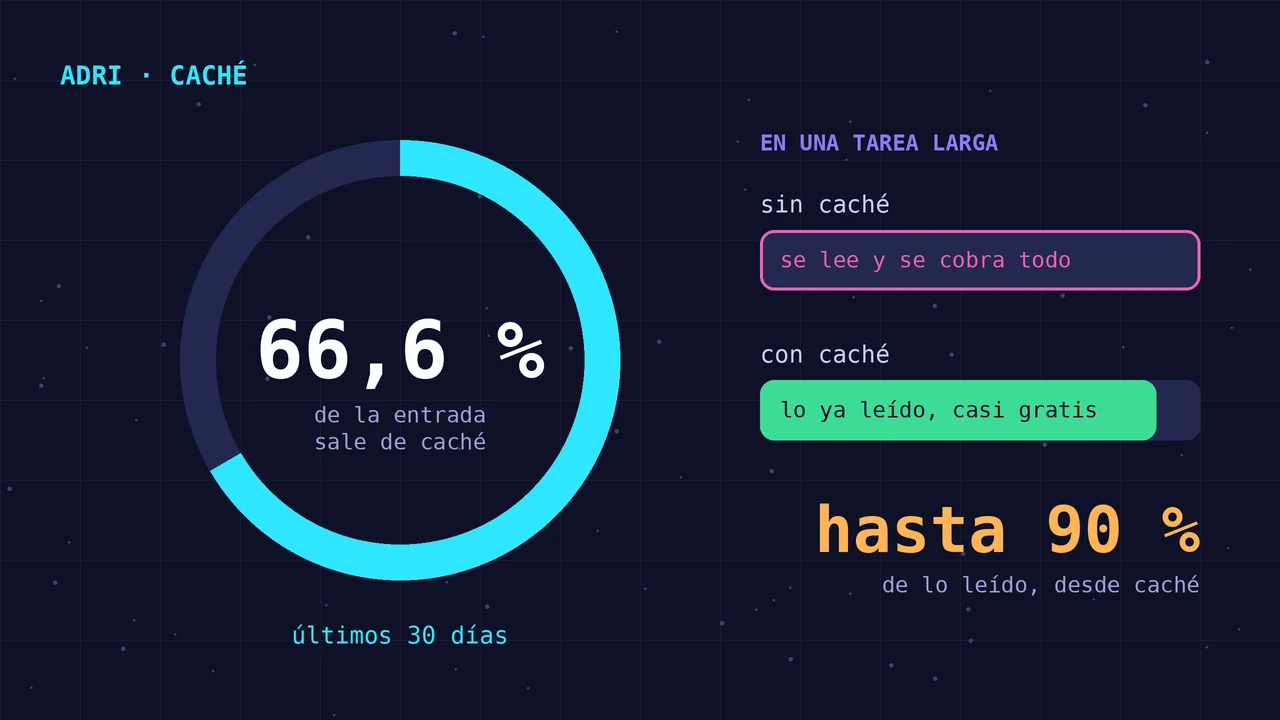
If you ask ADRI to prepare a quote, check your email or update a client in the CRM, it doesn't do a single read. It works in steps: it reads, uses a tool, reads the result and thinks again. And at each step the AI re-reads what came before. That repeated text is expensive, and the cache exists so that you don't pay for all of it every time.
The figures in this article are BionicAdri's own measurements, taken on our platform since we started measuring the cache, at the end of August 2026.
What ADRI reads at each step
When ADRI sets about a task, the AI always receives a text package. Inside are its instructions, the tools it can use, your company's context, the history of what it has done, and, at the end, your specific request.
From one step to the next, almost all of that package is identical. Little changes: the latest result from a tool or the next sentence in the conversation. Re-reading the same thing from scratch every time would be like asking an employee to read the entire company manual again before every call.
What the cache is, with a simple analogy
The cache is a short-term memory of the AI provider. If the beginning of the text is the same as a few moments ago, the provider recognises it, doesn't process it again and charges much less for it. It only works again with what is new.
Think of a filing cabinet with your client's folder already open on the desk. You don't take it out, you don't leaf through it again: you have it to hand and you only add the new sheet.
How much cheaper it is
On BionicAdri's public rate, one million input tokens costs 0,585 € and one million served from cache costs 0,06 €. That is almost 10 times less. If you don't know what a token is, it's explained in the Seats and tokens section of the pricing page, with input, output and cache.
| How to read it | Price per million tokens |
|---|---|
| Standard input | 0,585 € |
| Served from cache | 0,06 € |
How much cache is actually put to use
That the cache exists is not enough: you have to get it used. This is what we have measured:
- Week by week, since September 2026, between 63% and 71% of all input tokens are served from cache.
- In the last 30 days, 66.6% of about 1 billion input tokens came from cache, spread across 10,299 tasks. The measured saving is about 344 €.
And per task, the breakdown is this:
| Which tasks | Part that comes from cache |
|---|---|
| Half of the tasks, at least | 76 % |
| The top 10% | 87 % |
| Long tasks | up to 90% |
5% of tasks exceed 90%, and the maximum we have observed is 92.5%. Long tasks are the ones that gain the most, because they are the ones that re-read the most.
An important clarification: 90% is not a 90% discount on your bill. It is the part of what the AI reads that comes from cache in long tasks. That part is charged much more cheaply, but the rest of the task cost, such as what the AI writes, remains what it is.
How we achieve it
The provider only recognises the beginning of the text. If something changes at the start, it no longer matches and charges for everything again. That's why order matters.
What we do is order what the AI reads like this:
- First, the stable part: the instructions, the tools and the company context, always in the same order.
- At the end, what changes: the new request and the most recent results.
This way, from one step to the next, the beginning stays identical and the provider recognises it. Only the final part is processed again. It's a job of order and discipline rather than magic, and it shows every day.
What you gain
- Lower cost per task. It is one of the reasons why AI can be included in per-seat plans, with a fixed fee.
- Responses that start sooner. What has already been read doesn't have to be processed again.
- The same result. The cache doesn't change the AI's answer: it changes what it costs to read.
An example to give you an idea
Imagine you ask ADRI to review a client's pending invoices and prepare a claim email for you. To do so, it checks the ERP, reads the client's history, verifies the dates and writes the text. These are several consecutive steps.
At each step, ADRI's instructions, its tools and your company's context are the same. With the cache, that part is read once and reused in the following steps. Without it, it would be read and charged again each time. The more steps a task has, the more the difference is felt, and that's why long tasks are the ones that come closest to 90%.
In summary
ADRI does work, and working involves re-reading. Thanks to the cache, over the last 30 days 66.6% of what it read came from memory instead of being processed again, and in long tasks the proportion reaches up to 90%. For you it means cheaper and faster tasks, with the same quality.
If you want to understand how work is distributed among specialists, read how ADRI's agent system works. And if you have questions about figures or plans, write to us at [email protected].
- Cache
- Tokens
- Cost of AI
- ADRI