
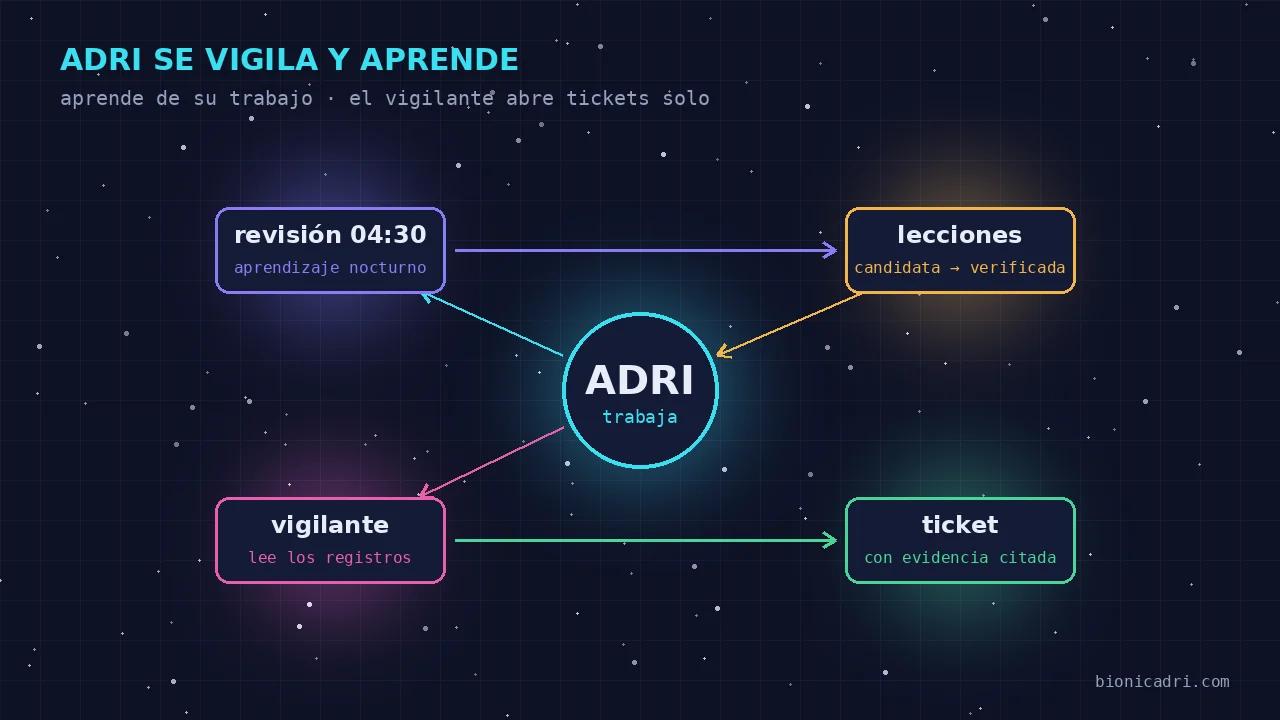
An AI that works every day makes mistakes every day. What matters is what happens next: whether the mistake repeats or whether someone detects and corrects it. In ADRI there are two mechanisms for that, and they work without anyone having to remember.
We explain how they work, what you see as a client and what guardrails they have.
The four ways ADRI learns
ADRI does not retrain any model with your data. It stores, organises and reuses what happens in its daily work, in four different ways.
- What it learns from you. When a conversation ends, a small, fast model reviews the exchange and updates your profile: how you prefer it to write to you, what signature you use, what corrections you have made to it. That profile is used for tone and preferences. It is not a source of data: if it needs an email or the status of an account, ADRI looks it up in the platform instead of pulling it from memory.
- Its conversation memory. Your previous chats and the files it generated for you are indexed every few minutes. That way it understands “what we looked at on the competition” even if that chat said “competitor study”. Each user only searches their own. If the search by meaning fails, it falls back to keyword search instead of returning an error.
- Technical lessons. When a tool fails and ADRI finds how to fix it, or when it gets stuck in a loop, or when you correct it, it can save a short lesson such as “for this case, do this instead”. We explain below why a new lesson is worth nothing until it has been proven.
- Per-tool experience. The browser, for example, remembers what works on each website and forgets old notes.
The rule that ties it all together is simple: store a lot, inject little. Stored memory can grow, but only a small, relevant piece reaches each conversation. That way each response doesn't become more expensive. We explain it in more detail in how semantic search works in the knowledge base.
The nightly review
Learning on the fly accumulates duplicates and notes that no longer apply. Every night a review runs to put things in order:
- It cleans user profiles. It removes duplicates, resolves contradictions (the most recent wins) and prunes.
- It reviews the lesson lifecycle. It promotes those that have proven to work, retires those that fail more than they succeed and merges those that say the same thing in other words.
- It retires lessons that no longer make sense. If it talks about a tool that its agent no longer has, the code retires it. It is a mechanical check, not a model's opinion, and it is reversible.
- It backs up the learning tables. A daily local copy, separate from the general backups.
- It saves the night's metrics. This way the trend can be seen instead of relying on intuition.
There is one more step that is today in test mode: a model compares each lesson with the agent's current instructions and proposes retiring those that are already covered or those that contradict them. For now it only proposes and notes it down; it does not touch anything until we review it. And even if it is activated, it can only retire a lesson if it literally quotes the part of the instructions that covers it, and never more than a third of an agent's lessons in one night.
How we prevent learning from breaking something
A system that learns on its own can learn lies: if it stores something that went wrong as a success, it will repeat it with more confidence. That is why almost all the work is in the brakes:
- A lesson starts as a candidate. It only becomes verified after several successful uses with no failures. If it fails more than it succeeds, it is retired. If it stops being used for weeks, it is retired too. If the error it corrected reappears, the lesson comes back to life.
- It only earns credit if it was actually used. A lesson about a tool only counts as a success if that tool was used in that task. A cancelled or half-finished task counts neither as a success nor as a failure.
- Personal data out. Technical lessons are shared across the whole installation, so they are cleaned of personal data twice before being saved.
- Lessons do not touch the fixed instructions. They are added as a note at the start of the request, at most the three most similar to the case. If something goes wrong, they are switched off with a toggle.
- Your profile cannot shrink by mistake. If, when updating it, the result comes out much shorter than the original, the change is discarded. Before rewriting it, a copy is saved.
- Tests do not pay for learning. Our test suites have a lock that prevents them from triggering real, billable learning calls.
- You can delete it. Roles with permission can wipe ADRI's memory in one go. By default, super-admin, admin and manager have this.
It is the same philosophy we describe in the harnesses that decide which model works and who reviews: the model proposes; the code checks.
The watcher: an agent that reads the logs
The second mechanism does not learn: it watches. It is a separate agent, the watcher, that runs on each server once a day, at a random time during the night. It reads what has been written in the ADRI and platform logs since the last time, groups errors by type and, if it finds a real incident, opens a ticket in our central support installation.
| Step | What happens |
|---|---|
| 1. Reading | It reads only what is new in each log, without skipping sections. |
| 2. Evidence | To open a ticket it must cite literal lines from the log, and the tool checks that they exist. If the citation is not in the file, the ticket is rejected. |
| 3. No duplicates | Each incident carries a fingerprint. If there is already an open ticket with the same fingerprint, no other is created. |
| 4. A common fault, one ticket | If the cause is in a resource shared by several servers, a single ticket is opened with several confirmations. If it is local, such as a full disk, one is opened per server, because they are different problems. |
| 5. Closure | Every morning, watchdog tickets whose error has not appeared for several days close by themselves. If it cannot measure it properly, it does not close. |
Steps 2 and 4 came from real errors. In July 2026 we reviewed the six tickets the watchdog had opened in two days: three cited counters and names that did not exist in any log. The model had invented plausible incidents. We do not ask it for honesty: we force it to cite lines that the tool can search for. That same month, a single fault in a shared resource opened seven identical tickets, one per server. Since then it counts as one.
What if the watchdog stops running? There is a second alert: every morning we check when its last successful review was. If more than 30 hours have passed, a ticket is opened to warn about it. And if it hangs or repeats the same action in a loop, it is cut off.
What you see as a customer
In day-to-day use, nothing. Watchdog tickets go to our support team, not to your inbox. The idea is that we find out about a fault from the log, often before it affects you. We will not always get there first: the watchdog checks once a day and some faults are only noticed when someone uses the feature.
What you do notice is the effect of learning: ADRI writes to you in your tone, remembers what you have already discussed and stops repeating some technical hiccups. If you want your own servers to open tickets with the same fingerprint logic, the platform has an API: you can find it in tickets and support with AI.
What it still does not do
- It does not repair itself. The watchdog runs in read-only mode. There is a second phase intended to close tickets after fixing the fault, but it is switched off and automatic repair has no real path today. A person does the fixing.
- It is not infallible. A watchdog ticket is an evidence-backed hypothesis, not a fact. We review it before acting.
- Learning is not understanding. A verified lesson has worked several times; it does not guarantee the next case.
- It measures, and sometimes the measurement also fails. In September we audited the nightly cycle itself and found that it marked the night as good even if a step failed. We fixed it.
If you want to see the list of agents and what each one does, it is in what ADRI does. To try it, start with the chat with ADRI. And if you are interested in how we handle the data it learns, you will find it in security and compliance.
- ADRI
- Self-learning
- Automated tickets
- Monitoring