
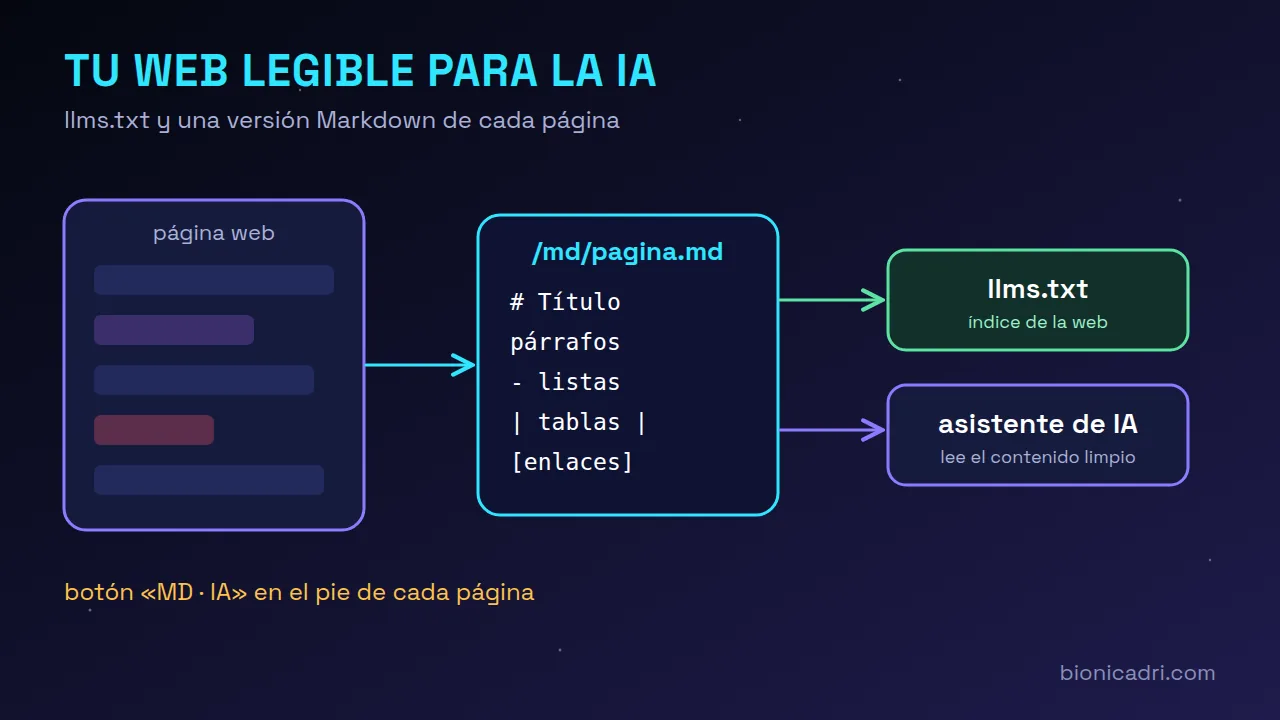
Until recently, writing for the web meant writing for people and for the search engine. Now there's a third reader: the AI assistants people ask “which company in my area does this?” or “how does that thing work?”. To answer, many visit pages, read them and summarise them. This work of preparing a website for them is sometimes called GEO, generative engine optimisation.
What is llms.txt?
It's a text file placed at the root of the website, at tudominio.com/llms.txt. It's written in Markdown, a simple text format that reads well for both people and programs. In a few lines it says who you are, what you offer and links to your important pages, each with a sentence explaining what it's about.
It's often accompanied by llms-full.txt, which brings the full content of the website together in a single file, for anyone who wants to read it all at once.
It doesn't replace robots.txt: that one says what can be crawled; this one gives context about what's there.
Why a Markdown version of each page?
A real web page carries much more than its text: menus, footer, cookie notices, buttons, scripts. To a person it's invisible; to a program trying to understand the page, it's noise that has to be separated from the content. If it gets that separation wrong, it misreads your page.
A Markdown version of each page is just the content: headings, paragraphs, lists, tables and links, in order. It's shorter, cleaner and hard to misinterpret.
How bionicadri.com does it
We use it on our own website, in all seven languages:
- Every page has its Markdown version at
/md/, and each language has its own (/en/md/,/fr/md/…), generated at the same time as the page so they never fall out of sync. - Every page links to its Markdown version in the header, so a program can find it without hunting for it.
- In the footer there's a MD · AI button that opens it, for anyone who wants to look at it or copy it into their assistant.
- Each language has its own
llms.txt(/llms.txt,/en/llms.txt…) listing all the pages and their link to the Markdown version.
Does llms.txt help you appear in AI assistants?
Here it's worth being honest. llms.txt is an open proposal, not a standard that everyone follows. Some assistants and tools read it; others don't. Google, for example, has said it doesn't use it for its search engine. No one can promise you that having it will make you show up when someone asks a particular assistant.
What it does do is remove an obstacle: if an assistant visits your website, you give it the content in the easiest-to-read format. It takes little work and does not harm your normal ranking. What will make you appear is still the usual: content that answers what people ask well, is clear, up to date and has data that can be checked.
What is the difference between SEO and GEO?
Traditional SEO is about getting your page well placed in a search engine's results list. GEO is about making sure that, when an AI assistant prepares an answer, it understands your content properly and can use or cite it. They are not opposites: almost everything that helps one helps the other.
The difference is in the reader. A search engine ranks links and the person chooses which one to click on. An assistant reads several pages and writes the answer itself, sometimes with links to its sources and sometimes without them. That is why it matters a lot to the assistant that the information is clear, unambiguous and easy to extract: a price, a deadline, an address or the steps in a process written exactly as they are, without having to infer them.
Neither of these can be achieved with tricks. Writing so that a program understands you is a lot like writing so that a person in a hurry understands you.
What can you do so AI understands your website?
- Clear answers. Real customer questions as headings, with the answer in the first paragraph.
- Structured data. Your company, your services and your FAQs marked up so that any program can understand them.
- An llms.txt and Markdown versions. Clean content for anyone who wants to read it that way.
- No hidden text in images. Almost no one reads what is only in a photo.
ADRI's SEO audit checks it
When you ask ADRI for an SEO audit of your website, among the checks designed for AI it looks at whether your site offers llms.txt and llms-full.txt, whether the page has the link to its Markdown version in the header, whether that address really responds with Markdown, and whether the server answers in Markdown when an agent asks for it. You'll see it in the appendix of the report: it's useful information, but it doesn't lower your website's score. If something is missing, it explains how to add it.
If you also want to know why other websites appear before yours, see why your competition appears before you on Google. More in SEO with AI or request a demo.
Frequently asked questions
What is llms.txt in a nutshell?
A text file at the root of your website that explains who you are and links to your important pages, in a format that is easy for AI assistants to read.
Does having llms.txt guarantee you will appear in AI assistants?
No. It is a proposal that some assistants read and others do not. It makes it easier for them to read you properly, but nobody can promise that you will appear.
Does it harm my ranking on Google?
No. It is a separate file that does not change your pages. Google has said that it does not use it for its search engine.
Where is the Markdown version of bionicadri.com?
Every page has its own at /md/ (and at /en/md/, /fr/md/… in each language), linked in the header and in the «MD · AI» button in the footer. The index is at /llms.txt and in each language's llms.txt.
- SEO
- GEO
- IA
- Web