
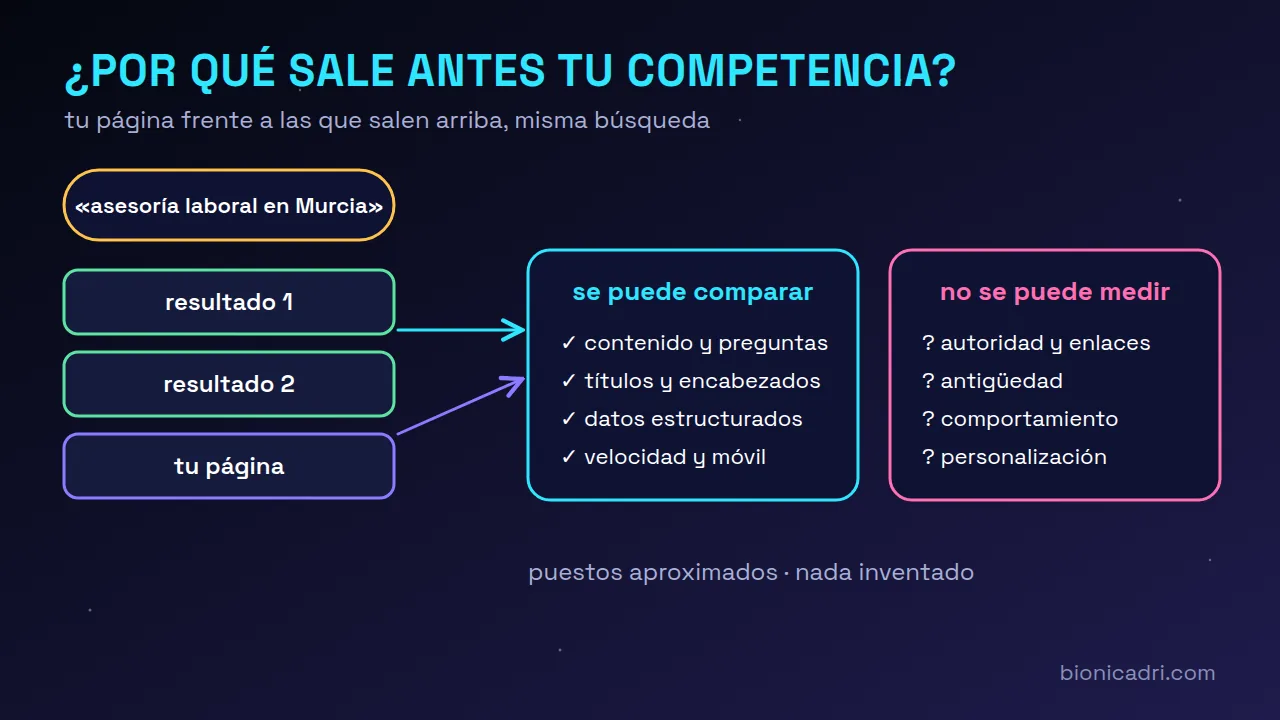
The usual answers to this question are generic: “they have more links”, “they've been around longer”, “they do more SEO”. They may be true, but they don't tell you what to do on Monday. What's useful is to look at a specific search, the specific websites that come up ahead of you and what they have that yours doesn't. That's what ADRI does when you ask it to compare your website with the competition.
Where does my website rank on Google?
You tell ADRI your page and the searches that matter to you, up to three. If you don't give it any, it takes them from your page title. ADRI searches Google and tells you where your website ranks today among the top results. If it doesn't appear, it says so plainly: “it doesn't appear in the top 10”.
That position is approximate. Google changes the results depending on where the search is made from, the language, the device and the person. That's why the report talks about what came up in that query, not a fixed position.
What does ADRI compare between your website and your competitor's?
It then reads the first 3 to 5 websites of your competition, one page per website, and compares them with yours point by point. Social media, major platforms and any PDFs that appear in the list are named, but not compared, because they aren't a website like yours.
- The search term on the sites that matter: whether it appears in the title, the page heading, the URL and the description.
- The page type: whether what comes up at the top are articles or guides and yours is a homepage, or the other way round.
- The content: how much text and how many sections it has, and whether it answers frequently asked questions.
- The structured data that allow Google to show rich results.
- Internal links and the alt text of images.
- The technical side: how long the server takes to respond, the update date, how it looks on mobile, the languages and whether it uses HTTPS.
- The version for AI assistants: whether it offers llms.txt or a Markdown version, as we explain in what llms.txt is and how it helps your website.
It only points out a difference when most of the websites it could read have it, or when the difference is big. That way it doesn't send you off to copy a detail that only one of them has.
What you get back: what they have and what you'd do first
With that comparison, ADRI tells you what they have that you don't, ordered by importance, and what you'd do first: up to five specific actions, not a list of fifty notices all of the same weight.
A real example. For the search “CRM with AI for SMEs”, what Google showed at the top were mainly articles and guides, and the page we compared was a product landing page. The first proposed action was to write an article dedicated to that search and link to it from the homepage. We did it: it's CRM with AI for SMEs: a practical guide.
What can't any tool measure from the outside?
ADRI always tells you this in the report, because it explains many cases where a worse-written page comes up ahead:
- The authority of your website and the links other websites point to you.
- The age of the domain.
- User behaviour: whether they stay or leave. Only the search engine knows that.
- Google's personalisation for each person.
If your page already has what the ones above have and still appears behind, the difference is probably here. Then the work is no longer about tweaking the page: it's about getting other websites to talk about you and publishing consistently.
Data that isn't made up
ADRI doesn't invent traffic or search volume for anyone. For speed, it only measures how long the server takes to respond, not the full page load, and it says so. And if a website couldn't be read, it appears as 'couldn't be read', never with zeros that look like a data point. A tool that gives you invented numbers is worse than having none, because it makes you decide with false data.
How to ask ADRI
Just write it in the chat: 'compare my services page with the competition for "employment advice in Murcia" and tell me what to do first'. ADRI returns in the chat the approximate position, the comparison and the actions.
More about the audit in SEO with AI: automated audits and about your website in campaigns, social media and WordPress, or request a demo with your own website.
Frequently asked questions
Does ADRI tell me the exact position I appear in on Google?
It tells you what position your website came in for that search, or that it doesn't appear in the top 10. It's approximate: Google changes depending on the location, language, device and person.
Can you tell me how many visits my competitor gets?
No. ADRI doesn't invent traffic or search volume. It compares what can be seen on the pages, not what only the search engine knows.
How many competitor websites does it compare?
It reads the first 3 to 5, one page per website. Social media, platforms and PDFs are named, but not compared.
Why does a worse-written page rank ahead of mine?
Often because of what isn't visible on the page: the website's authority, the links it receives, the age of the domain or Google's personalisation.
- SEO
- Website
- Competition
- ADRI