
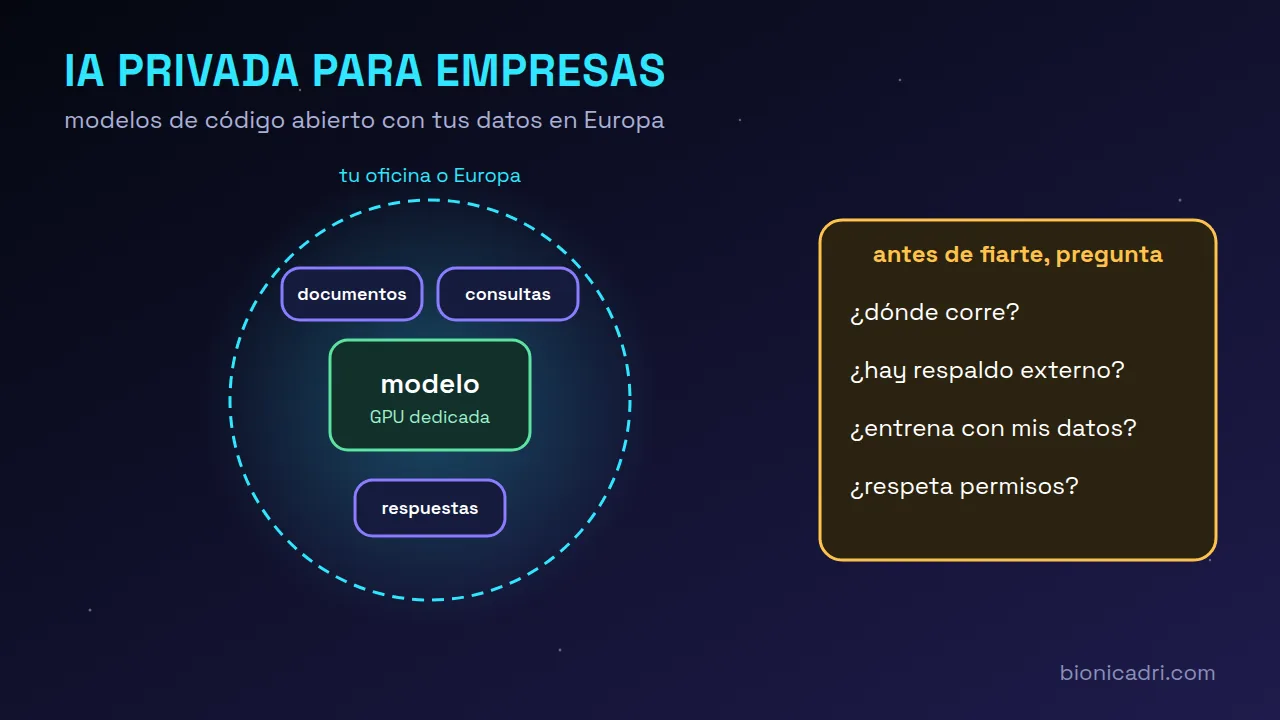
‘Private’ has become a buzzword in artificial intelligence and it doesn't always mean the same thing. For a company, what matters is knowing exactly where its data goes when someone on the team asks the AI to do something.
What is a private AI for businesses?
A private AI is an artificial intelligence model that runs on infrastructure controlled by your company or by someone you trust on your behalf: a server in your office or a server dedicated only to you. Your documents, your questions and the answers stay there. They are not shared with other companies or used to train someone else's model.
The opposite is using a shared AI service: you type into a website or an application and your request travels to another company's servers, which processes it alongside those of millions of users.
Why open-source models?
An open-source model is one whose weights — what the model has learned — are published so that anyone can download them and run them on their own machines. That is what makes a private AI possible:
- It works wherever you decide: in your office or on a dedicated server in Europe.
- You don't depend on a single provider. If a better model comes out for your task, you switch.
- You can choose according to the task. There are smaller, faster models for simple tasks and larger ones for tasks that require more reasoning.
Watch out for one nuance: just because a model can be downloaded doesn't always mean everything is published, such as the data it was trained on. For a company, what matters in practice is that it can run on its machines and that its licence allows commercial use.
Where can your data be?
- In your office. Server and GPU inside your network. Your data and your queries don't leave it.
- On a dedicated GPU in Europe. A server just for your company in a European data centre. You don't buy hardware and the power is all yours.
- Mixed. Your data in your office and the AI on a GPU elsewhere.
Any of the three can be private. The difference lies in who owns the machine, who maintains it and what happens if something goes wrong.
Is a private AI less clever?
It doesn't have to be. Open-source models have improved a great deal and, for a company's tasks (reading documents, drafting, summarising, classifying or answering with your data), they usually give good results. They have to be chosen well: you don't need the biggest model to read delivery notes.
What's more, what improves answers most is usually not the size of the model, but what it has in front of it: your documents, properly searched, with a RAG system. A private AI with your documents knows more about your company than a huge one that has never seen them.
What should you ask to find out whether an AI is truly private?
These are the questions we would ask any provider, including ourselves:
- Where does the model run? In which country and on which machine, and whether that machine is only for you.
- Is there fallback to external services? Some systems send the request to another provider if the main model is saturated. It can be reasonable, but you need to know and be able to say no.
- Is my data used to train anything? The answer has to be a written no, unless you ask for fine-tuning of your own model.
- Who can see the conversations? Which people in your company and at the provider, and whether a record is kept.
- Does it respect permissions? An employee should not be able to get from the AI what they cannot see in the software.
- What happens if I leave the service? How you get your data back and how it is deleted.
What do the GDPR and the EU AI Act say?
GDPR requires, among other things, knowing where personal data is processed, for what purpose and with what guarantees. Having the AI in your office or in Europe, with a clear contract, makes it much easier to answer those questions. The EU AI Act adds obligations depending on the use, such as telling people when they are talking to an AI. A private AI does not exempt you from complying with them, but it puts you in a better position to do so. If you have specific doubts, consult your data protection adviser.
How we do it at BionicAdri
We work with open-source models on servers in Europe and in the offices of those who need it. On the platform, each client has their own server, and we explain in detail where the AI runs and what exceptions there are, such as fallback to external services when the main model is saturated.
Besides ADRI, we set up custom private AI: GPU servers for rent with the private AI already running, in our European cloud or in your office; an open-source model dedicated only to you; servers you buy, installed and maintained; and RAG systems over your documents. If nothing leaving the building is a condition, it is set up without external fallback. If you are interested in the practical side of hardware, read AI server with GPU: buy or rent.
Frequently asked questions
What is the difference between a private AI and a cloud AI?
A shared cloud AI processes your request on another company's servers alongside those of many users. A private AI runs on a machine that is only for you, in your office or on a dedicated server.
Can a private AI be in the cloud?
Yes, if the machine is yours alone and you know where it is. A dedicated GPU in a European data centre is private even if it isn't in your office.
Are open-source models free?
The model can usually be downloaded without paying a licence, although each one has its own terms of use. What costs money is the machine that runs it and the work of installing and maintaining it.
Does a private AI comply with GDPR?
It makes compliance easier, because you know where data is processed and who sees it. Compliance also depends on how your company uses it and on the contracts you sign.
- Custom AI
- Privacy
- Europe