
When a company starts using artificial intelligence, the first complaint is usually the same: “it answers well, but it knows nothing about us”. It does not know your rates, or how you prepare a quote, or the small print of your contracts. A RAG is the way to give it that without changing the model.
What is a RAG, explained without jargon?
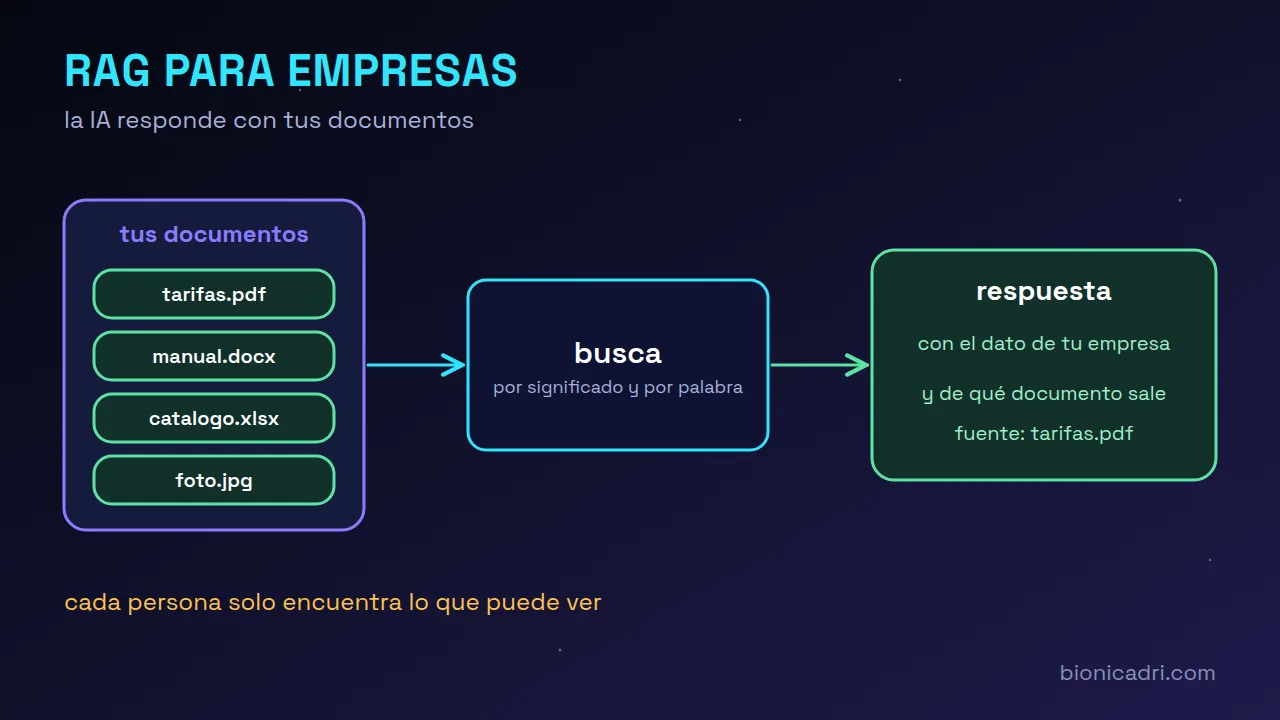
RAG comes from the English term retrieval-augmented generation, generation with prior search. Before answering, the AI searches your documents for the pieces that relate to the question and answers with them in view. It is like a new employee who, before answering a customer, opens the manual at the right page.
The model does not change: what changes is what it has to hand for each answer. If you upload the new price list tomorrow, the next answer already uses it.
What is a RAG used for in a company?
- Answering customers with what is already written in your terms, your catalogue or your FAQs.
- Answering team questions about procedures, holidays or how something is done, without always asking the same person.
- Checking contracts, technical data sheets or regulations that you have in PDF.
- Finding a piece of information in years of documents without knowing which folder it is in.
How does it work under the hood?
- Reading. The text is extracted from each document. Scanned pages, which are only images, must be transcribed beforehand; otherwise they add nothing.
- Chunking. The text is split into chunks that make sense on their own. Each chunk is given a line of context from its document so that it does not lose what it is about.
- Meaning-based index. Each chunk is converted into a vector that represents its meaning. This is how it finds “days off” even if you ask about “holidays”.
- Search. For a question, semantic search and keyword search are combined, and the chunks are ranked by how well they match.
- Answer. The AI answers with those chunks in front of it and can say which document each piece of information comes from.
Which documents work?
Almost all the ones you already have: PDF, Word, Excel, text, and images too, such as a photo of a whiteboard, a poster or a receipt. What helps most is not the format, but the order:
- Remove old versions and duplicates. If there are two price lists, the AI may use the wrong one.
- Put a date on what expires.
- Don't put data that already lives in your business management software into the RAG, such as invoices or customers: it's better for the AI to query it there, up to date.
Who can see what?
It is the most important question and the one least asked. A good RAG respects permissions: if the search only looks at what the person asking can see, an employee won't find the management folder even if it is in the same system. Separating company documents and personal documents, and making sure each person only sees their own, must be part of the design from day one.
How do you know if a RAG answers well?
A RAG can fail silently: if the search returns the wrong passage, the answer comes out well written and badly informed. That's why it has to be measured:
- A set of test questions with the correct passage for each one, to check whether the search finds it. It is repeated before and after every change.
- A screen to test the search with real questions and see which passages it returns and how similar they are.
- Review the documents that are read poorly and those that no one ever finds.
What about training a model with my data?
It is another technique, fine-tuning, which changes the model itself. For the AI to know things about your company it is almost never necessary: a RAG updates as soon as you upload a document and knows where each piece of information comes from. If your case really needs it, we'll look into it with you.
How we do it at BionicAdri
ADRI, BionicAdri's agent, already works like this with each company's document memory: it reads PDF, Word, Excel, text and images, transcribes scanned pages, searches by meaning and by keyword, and respects each person's permissions. For businesses that need something of their own, we build custom RAG, including without the platform: over your folders, your manuals or your business software's data, in your office or on servers in Europe, and measured with your own questions.
If you want to know where it would run, read private AI for businesses and AI server with GPU: buy or rent. Or tell us about your case.
Frequently asked questions
What is a RAG for businesses?
A system that, before answering, searches your company's documents for the passages relevant to the question and answers using them. The model doesn't change; what it has in front of it does.
Can I use my documents as they are?
Almost always. PDF, Word, Excel, text and images can be read; scanned files are transcribed first. What helps most is removing old versions and duplicates.
Does a RAG make things up?
It can get it wrong if the search returns the wrong passage. That's why it is measured with test questions and asked to state which document each piece of information comes from.
Do I need to train a model with my data?
Almost never, when the aim is for the AI to know things about your company: a RAG updates when you upload a document. If your case needs it, we'll look into it.
- Custom AI
- RAG
- SMEs