
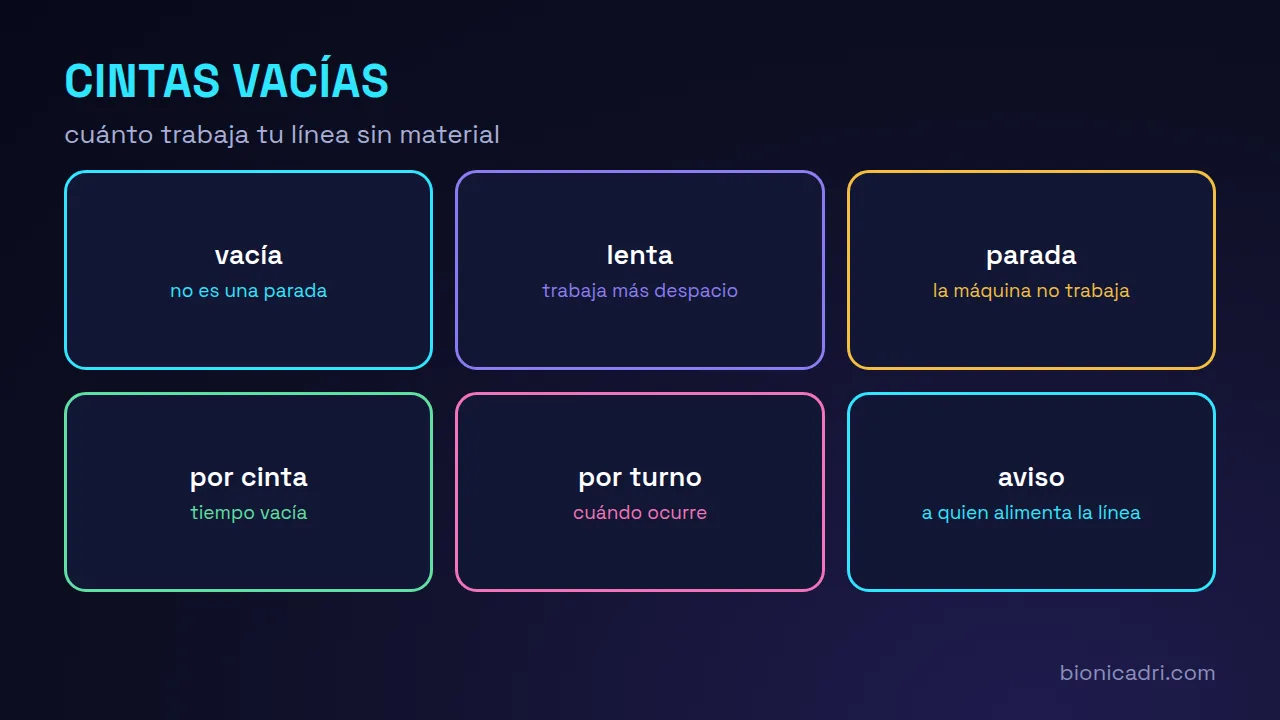
On a lettuce, broccoli or any bulk product line, there is a moment everyone knows and almost no one records: the conveyor belt is empty. The machines stay on, people stay at their posts and there is no breakdown. But no product is coming out. That time is lost without a trace.
Why an empty conveyor belt costs more than it seems
A packaging line has its capacity in kilos or boxes per hour. If the conveyor belt is empty, that capacity is not used and cannot be recovered: the hour has already passed. Moreover, an empty run is rarely just that belt. It usually means something upstream is failing: goods aren't arriving, someone is running late or an earlier machine is running slower.
The problem is that there is no button that says “empty conveyor belt”. It is not a stoppage or a breakdown. By the time it is noticed, it has already happened, and when someone records it, it is from memory and at the end of the shift.
What to measure
Three things, always per belt, per line and per shift:
- How long it runs empty. The sum of the periods when it carries no product.
- How often it happens. One long empty run is not the same as many short ones.
- What proportion of productive time it represents. It is the time spent empty divided by the time the line should be producing, excluding planned stoppages such as cleaning or product changeover.
With those three figures you can already compare lines, shifts and days, and start looking for the cause.
Empty is not stopped, nor is it slow
There are three distinct states, and it is best not to mix them up:
- Stopped: the machine is not working.
- Slow: it is working, but more slowly than planned.
- Empty: it is running at operating speed, but with no material to process.
BionicAdri's production control room already distinguishes a slow machine from a stopped one, and colours each one. The empty conveyor belt is the third case, and it is the one that escapes today.
Three ways to measure it
- By hand. Noting it in the shift report. It is what is done today, and it is unreliable: you write down what you remember.
- With a presence sensor. A sensor over the belt detects whether something is passing. It is cheap and simple. It says whether there is product or not, but it does not distinguish a belt with little material from an empty one.
- With a camera. A camera over the belt and an AI watching it see how much material it is carrying and how long it has been like that. It costs more, and is justified when you need to see more than presence.
If a sensor is enough, use the sensor. The camera is for when it is not.
What to do with the data
- Alert immediately whoever feeds the line, so they can act while the belt is still empty.
- Look at the summary by shift. If one shift concentrates the empty runs, the cause is usually in how it is fed, not in the machine.
- Look upstream. If a belt empties, what is the previous one doing? If the previous one has product, the fault is in the section that connects them; if it is stopped, you already know where to start.
- Separating normal empty periods. A product change or a cleaning leaves the conveyor empty and is not a problem. You have to discount them, or it is pointless.
Common underlying causes
Every plant is different, but the causes repeat. A shift change where feeding is interrupted for a while. An upstream hopper that empties and takes time to refill. A truck unloading that is slower than planned. A blockage upstream that cuts the flow without stopping the line. A product that arrives scarcer one day and does not fill the conveyor. Without measuring, they all look like “a bad day”. By measuring, you can see that each one leaves its signature: what time it happens, on which conveyor and how long it lasts.
Mistakes to avoid when measuring it
- Not defining what “empty” means. A conveyor with nothing on it for how many seconds? A normal gap between two boxes does not count. You set that rule, by looking at your line.
- Measuring presence without context. If you do not know when a product change or cleaning was taking place, empty periods will appear that are not a problem.
- Comparing different lines as if they were the same. A sheet line and a box line are not measured with the same yardstick.
- Alerting on everything. If every gap triggers an alert, by the third one nobody looks at it. Better to alert less and make every alert matter.
- Stopping at the number. Empty time is the symptom. What is useful is what you do next with the cause.
How it looks in a shift report
The ideal is a simple view: for each conveyor, how long it has been empty, how many times and in which time slot. Next to it, the reason for stoppages in the same shift, which the kiosk already records. With both together, the line manager can see whether the shift lost time because of stopped machines or because a line was waiting for material, and does not have to guess.
How we set it up
Today BionicAdri does not analyse video in real time. What works today is the production control room: stoppages with their reason, status and count sensors, and OEE. We build camera-based empty conveyor detection as a custom solution, and we do it like this:
- A pilot on a single line, with your real product, unlike any other.
- The AI runs on a GPU server at your plant or in Europe, and the images are processed there and stored for a short time.
- The conveyor is monitored, not people. We cover the rules for cameras in the workplace in this other article.
If you want to see how it would look on your line, see the empty conveyor detection page or tell us about your line.
Frequently asked questions
What exactly is an empty conveyor?
The one that is running but has no material to process. It is not a stoppage or a breakdown: the machine is working, but there is no product.
Is a camera needed to measure it?
Not always. A presence sensor on the conveyor may be enough. A camera is justified when you need to tell how much material it is carrying.
Are the people feeding the line measured?
No. The conveyor is measured. What is stored is time by conveyor, line and shift, not data about people.
- Agri-food
- Conveyors
- OEE