
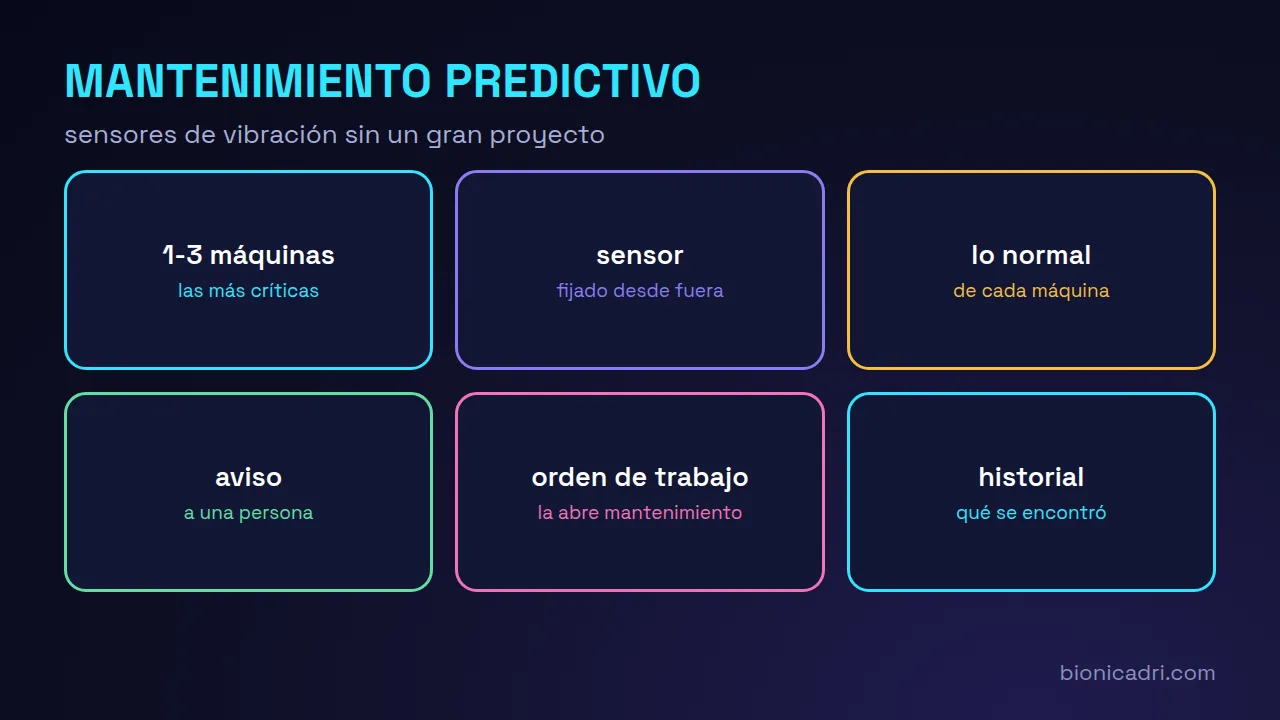
Predictive maintenance sounds like a big project, with a consultancy, hundreds of sensors and a year of implementation. For an industrial SME it doesn't have to be like that. You can start with one machine, one vibration sensor and a simple question: is this vibrating as usual?
Three ways to maintain a machine
- Corrective: you fix it when it breaks. It's the most expensive and the most common.
- Preventive: you service by calendar, every so often or every so many hours of use. It prevents many breakdowns, but it services machines that didn't need it and misses the one that fails between services.
- Predictive: you look at the real condition of the machine and act when it starts to change.
The two don't rule each other out. Preventive maintenance is still needed, and predictive covers what the calendar doesn't see.
What vibration tells you
A machine that turns has a vibration pattern. A bearing starting to fail, an unbalanced shaft, play or poor alignment usually change that pattern before the fault is visible or audible. A sensor fixed to the machine measures it, and the change shows in the data before it shows on the shop floor.
The trap is in the threshold. A single limit for all machines doesn't work: an old pump can vibrate more than a new one and be perfectly fine. The right reference is the machine itself: how it vibrates when everything is fine, in its usual conditions.
Start small
Choose one, two or three machines with these characteristics:
- When it stops, it costs a lot: it stops the line or there are orders waiting.
- The spare part takes a long time to arrive, or the repair takes time.
- It has already given you trouble, or it has rotating parts such as motors, pumps, fans or gearboxes.
You don't need a sensor at every point or on every machine. A project that starts with everything usually ends up unfinished.
What the system has to learn
Before raising an alert, the AI needs to see how the machine works in its normal situations: with each product, at each speed, under load and running empty. A machine that always does the same thing is learned faster than one with many products. Until it has enough history, the sensible thing is to alert with caution and review the first alerts with someone who knows the machine. An alert only counts if it persists, not if it's a one-off spike.
The alert has to end up with a person
Data that never reaches the person who can fix it is useless. The alert has to say which machine, what it has seen and what is worth checking, and reach maintenance through a channel they actually read. After that, a person decides. At BionicAdri, the workshop work order is opened by a person pressing a button, on purpose: that way a badly set sensor doesn't fill the workshop with false orders.
What does work today in the maintenance module:
- Work orders: pending, in progress and completed, with the work carried out.
- Preventive maintenance every set number of days, with an email and bell notification when due.
- Spare parts with their stock and reorder point, and alerts that are acknowledged and resolved.
Which sensors are used
To start with, three types of measurement are enough, all fitted from the outside: a vibration sensor (an accelerometer) on the motor or bearing housing, a temperature sensor at the same point and, if you want, a measurement of the motor's power consumption. You do not need real-time to the second: taking measurements at intervals, sending the summary and storing the history is enough for most machines. The important thing is that the sensor is securely fitted and always in the same place, because a change of position changes the reading.
How to know whether it is working
Without making up figures, there are simple questions you can ask yourself every few weeks. Were the alerts it gave correct when the machine was opened? Have there been unplanned stoppages on the monitored machines? Has any machine stopped without the system alerting? Are there few false alerts, and can they be explained? With those answers, you adjust when to alert and decide whether it is worth extending the system to more machines.
The history, your most valuable asset
Every time a machine is opened because of an alert, what is found is information: whether the alert was correct, which part was faulty and how long it had been vibrating differently. Recording it on the work order closes the loop. Over time, your plant has a history that no generic table can give you, because it is the history of your machines, with your products and your conditions.
Typical mistakes
- Sensors everywhere without knowing what will be done with the data.
- Fixed thresholds copied from a table, instead of each machine's normal behaviour.
- Alerts nobody reads. If they do not reach a specific person, people stop looking at them.
- Not having the spare part. Warning in advance is useless if the part takes weeks to arrive.
- Not closing the loop. You have to note down what was found when the machine was opened, to know whether the alert was correct.
How we approach it
We build the custom sensor and learning setup for each machine: today it is not included in the product. We start with a pilot on one or two critical machines, with the AI on a GPU server at your plant or in Europe, and we decide with you who is alerted about what. These sensors measure machines, not people: there are no images or sound of anyone.
If you want to see whether it fits your machines, see predictive maintenance with sensors or tell us about your production line.
Frequently asked questions
Do the machines need replacing?
No. The sensor is attached to the machine from the outside, without touching its control system, including on older machines.
Does predictive maintenance replace preventive maintenance?
No, it adds to it. Calendar-based preventive maintenance is still needed, and condition-based alerts cover what the calendar does not see.
Which machines should be monitored first?
The ones that are costliest to stop, take longest to repair and have already given you problems, especially if they have rotating parts.
- Maintenance
- Sensors
- Industrial SMEs